Abstract: This graduate level assignment requires students to analyze rhetorical artifacts through an African American epistemology of rhetorical knowledge. I built expectations of the assignment on the concepts of Kemetic-rooted (Ancient Egyptian) rhetorical traditions that U.S. Black communities share every day. The assignment worked towards helping learners demonstrate foundational declarative and procedural knowledge of the practices and frameworks within an African American rhetorical tradition that would help them expand their understanding of rhetorical aims throughout the course and beyond. This assignment expanded how students perceived the relationship between rhetoric, society, culture, and community both historically and contemporarily. For some students, working with a different rhetorical mindset allowed them to theorize about rhetorical communication in ways they feel they had not been able to articulate in previous courses or contexts.
Can I educate rhetoric and writing graduate students in the foundations of rhetoric through a course that centers African American rhetorical traditions and histories? Can I teach in this way intentionally decentering Platonic-Aristotelian rhetorical perspectives? These questions were the kindling that ignited my passionate pursuit to create a graduate course on African American rhetorical traditions. At the center of the course’s identity lies the goal of critical thinking about rhetoric, language, knowledge, and choice. These areas of interest reinforce every general course in rhetoric, but in this case, students would be doing so without the taken-for-granted rhetorical knowledge we in the West have assimilated into thanks to K-16 education. I created and taught an African American Rhetorical Analysis assignment to assess students’ early comprehension and application of this unfamiliar but cultural-historically grounded rhetorical knowledge system.
Just as I would with teaching the practices of any other rhetorical tradition, I knew I needed to center a cultural perspective that informed the rhetorical tradition within the U.S. frame of reference. Coming from a cultural rhetorics framework, I sought to move students to center Afrocentric theoretical and methodological approaches to rhetorical studies, within the American context, and constellate, or bring together to create shared meaning from multiple experiences, those to other rhetorical traditions and cultures. Further, I intended to take them to the point where they felt comfortable analyzing and critiquing works through an African American rhetorical lens in all of their graduate courses in rhetoric. I think in my mind, I envisioned a student in their Rhetoric of Social Movements course, for example, contributing to the discussion by explaining that an orator failed to move their audience due to lack of interconnectedness and an inefficient use of magara both critical rhetorical knowledge in Afrocentric rhetorical traditions, both critical concepts of Afrocentric rhetorical traditions. I describe magara in more detail later.
These intentions meant that I needed to refresh and expand my own engagement with these traditions. I by no means consider myself an Afrocentrist or even an African American-centrist in scholarship. This admission might surprise my students and colleagues. I aim to center African American perspectives and knowledge systems in my research and teaching, because I am Black and American, and I’m an African American cultural rhetorics geek. In the same way that I go deep into the works of sci-fi/fantasy authors and K-pop idol groups, I go down curiosity rabbit holes in discussions of signification, indirection, nommo, narrativizing, call-response, stylin', hip-hop. To plan, develop, and teach the fully asynchronous online course, African American Rhetorical Traditions, I went beyond my nerd girl fascination with the writings of Carmen Kynard (2013), Elaine B. Richardson (2003), and so many others. Teaching African American Rhetorical Traditions required demystifying a long tradition of rhetoric that could help graduate students develop in more adaptable, community-centered rhetoricians and writers. The African American Rhetorical Analysis was an early step in their developing knowledge and application of this tradition.
“I write like this. It makes more sense to me.” First-year Graduate Student enrolled in African American Rhetorical Traditions
The first step to teaching the course and creating the African American Rhetorical Analysis assignment was to gain permission to do so. Yes, the graduate catalog listed Rhetorical Traditions as an elective course for students of writing and rhetoric and other humanities programs. Mind you, though, I would be the first faculty to teach the course from an Afrocentric perspective of rhetorical practice. The most prominent reason to request approval for this was recent legislation that impacted graduate education, along with K-16 instruction in the unfree state of Florida. In some ways, I still believe my course met the restriction, “Core courses may not …include a curriculum that … is based on theories that systemic racism, sexism, oppression, and privilege are inherent in the institutions of the United States” (Higher Education. Senate Bill 266, Florida Senate 2023). I developed the following outcomes:
Define the African American rhetorical tradition.
Identify and explain African American rhetorical patterns in any given discourse.
Position the Western Aristotelian rhetorical tradition in relation to the African American rhetorical tradition.
Implement an African American-centric construct for rhetorical analysis.
Center an African American rhetorical approach to important inquiries about language, writing, literacy, and education in the field of composition studies.
Formulate arguments that illustrate value and appreciation of the role of African American rhetoric in the field of composition studies.
Although I did not explicitly address Florida state’s criminalized pedagogies in my course, I have no doubt that many students inferred that, among many other sociopolitical conditions, systemic racism, cultural oppression, and cultural privilege were at the core of the often-asked question, “Why haven’t I learned this before?” And because speaking about rhetorical traditions and practices without discussion of cultural influences and implications is talking out the side of your mouth, the lessons in African American Rhetorical Traditions had to include brief surveys of pre-Transatlantic slave trade and cultural histories of Afrocentric rhetorical perspectives.
Despite this factor, the graduate programs director encouraged my path forward, including use of the textbook, Understanding African American Rhetoric: Classical Origins to Contemporary Innovations, edited by Ronald L. Jackson II and Elaine B. Richardson (2003). She believed, as I do, that education and composition-rhetoric has to share multiple ways of being rhetorical. My course consisted only of students concentrating in rhetoric and composition and creative writing in our university’s Master of English program, some who began the degree program with this course, some who ended the degree with my course, and still others who enrolled in the course midway through the program. The diverse student body ranged from middle-aged Caucasian American women teaching K-12 or retired and returned to school to Black American and West African, Latinx, and international students at disparate points of their lives.
Coming into the degree and the course, many students had a background in English literature, so they weren’t accustomed to thinking about the rhetorical application of language in the ways I required to engage with the material. Not to mention, Aristolelian-Platonic paradigms grounded their perceptions of effective rhetorical practice. Therefore, my approach needed to be careful to capture the minds of students who came with no knowledge of rhetorical traditions outside of Western rhetoric. For example, a few students had taken a course on Global Black Rhetorics previously in the department, so that course prepared them for a few of the concepts in my course. To account for the breadth of experience in this 17-student-body class, I drew on cultural rhetorical pedagogies and writing-to-learn practices, such as the African American Rhetorical Analysis assignment.
Entry paths into African American rhetoric are as diverse as any rhetorical knowledge system, so I relied on the wisdom of my scholar-ancestors and contemporaries to help me structure the course in a logical way to grasp the basic concepts for appropriate application of this tradition. The African American Rhetorical Analysis assignment acted as one crucial measure to guide students to this outcome. I drew on the scholarship of the following researchers and many others:
Molefi Kete Asante (2003)
Geneva Smitherman (1977)
Esther Milu (Browdy and Milu 2022)
Ronisha Browdy (Browdy and Milu 2022)
Elaine B. Richardson (2003)
Ronald L. Jackson II (2003)
Maulena Karenga (2003)
These scholars helped position me with the instructional resources to help students know what the hellutalmbout1 in African American rhetorical practice. The most influential sources in developing the rhetorical foundations of the course were African American Rhetoric(s): Interdisciplinary Perspectives, edited by Elaine B. Richardson and Ronald L Jackson II (2004); Talkin and Testifyin: The Language of Black America by Geneva Smitherman (1977), and the aforementioned textbook Understanding African American Rhetoric (2003). While I relied on the former two resources to support exploration of modern African American rhetorical practice through the use of discourse modes and literacies, the latter provided extensive knowledge on the origins of Afrocentric rhetorical traditions out of ancient Kemetic society and social order.
I think it bears repeating that I am not an Afrocentrist, or a scholar who specializes in Africanist culture and history. Like you, most likely, I grew up in a system of rhetorical education that omitted any recognition of Africanist language culture, despite the fact that the Ancient Egyptian, or Kemetic, system of medet neferet long-preceded the widely accepted rhetoric epistemologies of Aristotle and Plato. As my students learned from the Book of Ptahhotep via Karenga (2003), the Kemetic term medet neferet means “eloquence and effective speech itself” (p. 11), and its rhetorical influence undergirds the generative power of the word, or nommo, in African American rhetorics.
The African American Rhetorical Analysis assessed students’ application of these concepts along with others that are central to African American rhetorical traditions and uses of rhetoric across rhetorical traditions. Because many scholars of African American rhetorics and other Global Black rhetorics (Browdy and Milu 2022) recognize the lack of rhetorical analysis models utilizing an African American rhetorical knowledge epistemology, the authors we studied in the course provided examples for me to teach and for students to model.
I set the assignment deadline for Week 5 of the 15-week semester. Students built experience in working with the concepts through studying readings from the textbook and engaging with the weekly online lecture notes. As the African American Rhetorical Analysis assignment indicates, final submissions should have investigated the rhetorical efficacy of one of the listed concepts or constructs of Afrocentric rhetorical practice that influence the African American rhetorical tradition in three student-selected rhetorical artifacts. Scaffolding for this assignment began during the first week of class with establishing rhetorical knowledge, such as the aims of the rhetorical tradition.
I aimed to begin with basic constructs in the same way that rhetorical education in the Western tradition begins with an understanding of ethos, pathos, and logos. The Kemetic rhetorical canons established a fundamental backing to this study of rhetoric, because, as I shared with students, they indicate the values inherent in the cultural rhetoric of this rhetorical community. I use the idea of the rhetorical community as Woodyard (2003) conceives it, or individuals who come together in response to oppressive social conditions and empower each other to create collective rhetoric that affirms their humanity (p. 138). Those canons include restraint, good timing, fluency, silence, and truthfulness. And they link with the ethical concerns of “the dignity and rights of the human person” (Karenga 2003, p. 14), “the well-being and flourishing of community” (p. 16), “the integrity and value of the environment” and “the reciprocal solidarity and cooperation of humanity” (p. 18). My course mainly focused on medu nefer or good speech, and its relationship to the “most important … canon of truthfulness” (Fox, 1983, as cited in Karenga, 2003, p. 11). In their rhetorical analyses, two students chose to take on the tension between truth-telling and persuasion by all available means. Throughout the course we returned to the critical question of why truth-telling and the power of the truth is vital to this rhetorical practice.
Much of this context for African American rhetorical traditions came from the chapters in the textbook, “Nommo, Kawaida, and Communicative Practice” by Maulena Karenga (2003) and “Africological Theory and Criticism: Reconceptualizing Communication Constructs” by Jeffrey Lynn Woodyard (2003). This book knowledge was complemented with my research-based living practice (Karenga 2003, p. 5), or what some call “street knowledge,” of the concepts. The principle of magara provided direct support to this curriculum, as the principle “invokes our ability to ‘strengthen’ and/or ‘weaken’ another toward a particular interpretation or understanding” (Woodyard 2003, p. 136). This rhetorical concept is critical to African American rhetoric as it signals strong and/or weak impact that is activated together with rhetorical practices and rhetorical communities (Woodyard 2003, p. 137).
Magara and the spirit of morally good speech (medu nefer) provided the framework for examining African American rhetorical modes more critically, along with the concept of nommo. In weekly assignments, such as reading responses, students were tasked with connecting material from the readings to ideas provided in the lecture notes. Key to making these connections was the rhetorical concept of nommo. Nommo, or the power of the word—both spoken and written—is as foundational to the African American rhetorical knowledge as the means of persuasion are to Aristotelian rhetorical knowledge systems. This concept of nommo undergirded all of our work on the subject, and the lessons leading to the Rhetorical Analysis privileged discussions and applications of “nommodic rhetorical behaviors” (Woodyard 2003, p. 140). These behaviors, such as the magara principle, illustrate the effect of nommo in communication. In conjunction with the study of Geneva Smitherman’s Black modes of discourse, students developed the capacity to start formulating informed inquiries about rhetorical practice from an Afrocentric framework. By requiring students to include a set of three texts in their corpus for the Rhetorical Analysis, I wanted them to reflect on the affordances and potential universality of the African American rhetorical tradition when it comes to particular kinds of academic, public, and civic writing.
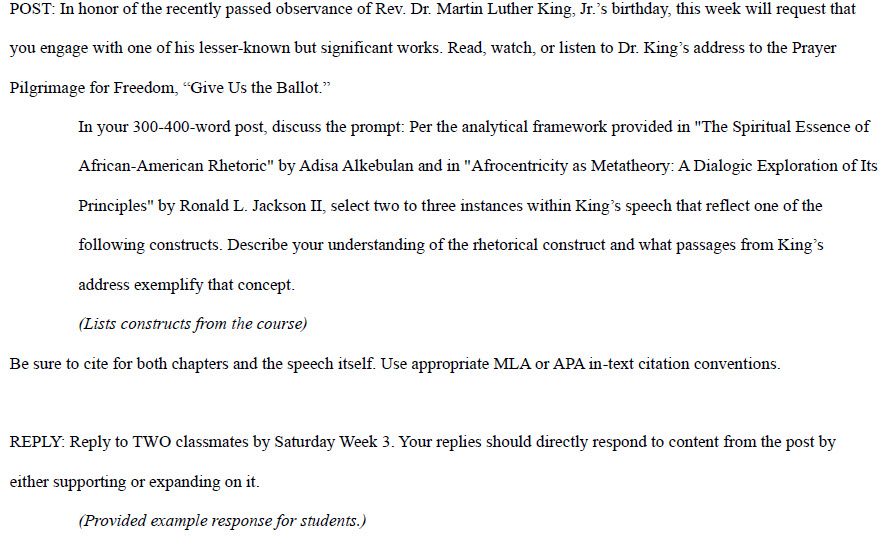
Using these combined explanations of the concept, I gave students access to multiple ways of making meaning from these constructs and their practices. To examine concepts, the reading responses and online discussions that I required for students included clear, real-world examples for students to examine. Figure 1 shows the discussion forum activity students completed in Week 3.
This low-stakes activity acted as an essential building block for the Rhetorical Analysis assignment, not only for examining my class’s capacity for working with these rhetorical constructs, but also for practicing the kinds of terminology and diction they would need to get the ideas of these discussions across. After all, the African American Rhetorical Analysis called on students to identify and describe “the presence of (or not) African American or Afrocentric rhetorical themes, purposes, or behaviors.” Some students began their foray into African American rhetorics by placing them in comparison or contrast to what they know about rhetoric. This wording was theirs, connoting that they viewed neo-Aristotelian rhetorical traditions as the center of rhetorical theory. Much of my teaching on these attitudes happened through the feedback I provided on low-stakes assignments, with comments such as, “Does this point work if we see Afrocentric rhetorical practices on their own?” and “What purpose does it serve to include this citation from Aristotle’s Rhetoric?”
Please don’t misunderstand me; we spent plenty of time during the course discussing how different cultural developments resulted in specific rhetorical purposes and cultural rhetorics. In fact, one of the student learning outcomes listed above explicitly calls for students to “position the Western Aristotelian rhetorical tradition in relation to the African American rhetorical tradition.” At this point, however, their objective was to acclimate to the foundational concepts and constructs of African American rhetorical traditions by implementing an African American-centric construct for rhetorical analysis. The African American Rhetorical Analysis additionally acted as their first formal attempt to center an African American rhetorical approach to important inquiries about language, writing, literacy, and education in the field of composition studies. The target audience of popular rhetorical studies journals strengthened the rhetorical situation for the assignment and gave students hands-on understanding of the vast reach of African American rhetorics within broader rhetorical studies.
Students took a few approaches to the assignment, with many deciding to analyze works from famous black writers, such as Rev. Dr. Martin Luther King, Jr. or James Baldwin. One successful assignment examined the purpose of “show the truth” in Dr. King’s (1957) “Give Us the Ballot,” Malcolm X’s “Message to the Grassroots,” and Abraham Lincoln’s “The Gettysburg Address.” The student concluded that showing a version of the truth was more critical to the works of Dr. King and X, while constructing a narrative of truthfulness presented more in the “Gettysburg Address.” Although this student struggled to show restraint in the scope of their submission, they succeeded in good timing, or “an understanding of when to introduce new ideas and transition across discussions” and providing insights from relevant secondary sources, or truthfulness. This outcome contrasts with another student who analyzed the creations of musical artists, including Bob Dylan, Marvin Gaye, and Stevie Wonder, and demonstrated excellent silence and fluency practices. They provided a tight rhetorical analysis that centered “the dignity and rights of the human person” and complemented it with strong secondary source evidence. They found that even as Dylan came from a Caucasian American background, he employed clear intentions to show the dignity and rights of the human person in his song, “I Shall Be Released” with The Band. This analysis connected approaches to the same themes in Gaye's “What's Going On?” and Wonder’s “Living for the City.”
I gave both examples high grades due to their strong analysis based in African American rhetorics and their successful demonstration of African American canons of rhetoric.
An aspect of the assignment I wished I would have maybe spent more time teasing out is the audience and venue component. Audience was a great focus of my instruction, because harmony and interconnectedness with community as audience is foundational to African American rhetorics. Karenga (2003) affirms that “African rhetoric is first of all a rhetoric of community” (p. 5). He also emphasizes “the well-being and flourishing of the community” (p. 16) as an ethical practice of African American rhetoric. As one of the assignment components challenged to target a community of “the editors and readers of an academic journal in rhetorical studies (community-centered rhetorical practice)” with “the expectations, needs, and goals of the target audience in mind.” Upon re-teaching this course or a similar one, I would love to focus on academics, researchers, and scholars as readers within a rhetorical community that students belong to and aim to build rhetorical knowledge alongside. Another assignment that became due after the African American Rhetorical Analysis gave students the opportunity to play around with some of these aspects. But I hope to strengthen the focus in the course and in future iterations of this assignment.
This assignment requests that you perform a rhetorical analysis using the purposes, principles, and canons of Afrocentric rhetorical theory to a small corpus of texts. You should draw knowledge from the course reading assignments and the lecture notes to help frame your analysis with these elements appropriately. This analysis will require you to apply the canons of Kemetic rhetorical traditions as you may be accustomed to with Aristotelian traditions. This means that your essay will need to demonstrate …
Silence - effective use of quiet and rhetorical listening to learn
Restraint - demonstrate eloquence with what not to say
Fluency - exhibit verbal dexterity and deep comprehension of topic and message
Good timing - deliberate use of time to strengthen effect of the message
Truthfulness - privilege the truth in rhetorical communication
More on how you might exhibit these canons in the Assignment Instructions.
This assignment will also call on your attained knowledge of African American rhetorical themes to analyze your chosen corpus.
Compose an extended African American Rhetorical Analysis of a corpus of three texts. Your analysis will use the frameworks of Afrocentric rhetorical practice and African American rhetoric you have studied in ENC6335 to present an argument about the Afrocentric rhetorical practices within your corpus. To demonstrate the reach and versatility of Afrocentric rhetorical philosophy, your corpus of primary sources must include 2 texts from Black American rhetors or authors and 1 text from a non-African rhetor or author. The selected texts can come from any genre, but they must result in a rhetorical analysis not a literary analysis.
In 10-12 double-spaced pages, your African American rhetorical analysis will examine the tep-heseb en medet neferet through the presence of (or not) African American of Afrocentric rhetorical themes, purposes, or behaviors in the texts of your corpus. You will present and support an argument about the workings of one of the following African American themes, purposes, or behaviors:
Themes:
The dignity and rights of the human person
The reciprocal solidarity and cooperation of humanity
The integrity and value of the environment
The well-being and flourishing of community
Purposes:
Building community
Communal deliberation
Reaffirming human dignity (reaffirmation)
Enhancing the life of the people (possibility)
Liberation
Resistance
Show the truth
Bring good into the world
Nommodic rhetorical behaviors (manifestations of nommo) (Woodyard):
Rhythm as a frame of mentality
Lyrical approach to language
Call and response of participation
Reliance upon mythoforms
Use of indirection
Repetition for intensification
To perform this task effectively, you are asked to complete the steps below in your essay.
Respond to the guiding questions: How does the application of particular themes, purposes, or behaviors in these texts reflect or represent African American rhetorical traditions or not? How effective are the themes, purposes, or behaviors in the corpus texts? What practices does the author use that demonstrates that theme, purpose, or behavior? What is the magara of the use of the rhetorical concept?
Demonstrate restraint: Provide a detailed introduction that introduces and gives a good overview of the rhetorical concept you are analyzing.
Explain focus of the essay and specify elements under analysis.
Stay within assigned task length and time constraints.
Demonstrate silence: Provide a discussion of secondary research sources and their perspectives on the topic.
Demonstrate fluency: Provide historical and cultural context for the discussion of your corpus texts and rhetorical concept.
Perform a close and critical analysis of three texts (see requirements above) only.
Use carefully selected diction and syntax in construction of writing.
Demonstrate good timing: Employ effective organization throughout the structure of your essay.
Show an understanding of when to introduce new ideas and transition across discussions.
Demonstrate truthfulness: Frame and support your analysis with concrete, specific evidence from primary sources of your analysis and with the thoughts and theories of others through your secondary research.
Incorporate insights from 6-8 relevant secondary sources, at least half of which are scholarly and peer-reviewed and two of which were assigned in ENC6335.
Your target audience for this essay are the editors and readers of an academic journal in rhetorical studies (community-centered rhetorical practice). Select from one of the venues below:
Rhetoric Society Quarterly
Philosophy and Rhetoric
Peitho: The Peer-Reviewed Journal of the Coalition of Feminist Scholars in the History of Rhetoric and Composition
Rhetoric Review
African American Review
Rhetorica: A Journal of the History of Rhetoric
constellations: a cultural rhetorics publishing space
You should craft your analytical essay with the expectations, needs, and goals of the target audience in mind.
Select a rhetorical concept to frame a rhetorical analysis of a corpus of three texts from three separate authors per the required elements detailed above.
Illustrate understanding of the canons of Kemetic rhetorical traditions per the expectations described above.
Responds to the guiding questions.
Appropriate use of secondary sources, per the expectations above.
Audience-aware (community-conscious) choices demonstrated through fluency, timing, and restraint.
On-time submission in the Webcourses assignment space.
Due Date
Friday Week 5.
Hellutalmbout is a Black American vernacular phonetic spelling of “the hell are you talking about,” posed as a question in response to an unbelievable, ridiculous, or confusing assertion.↩︎