Abstract: This progression of assignments from Advanced Writing and Research in the Arts, a seminar for Tisch School of the Arts students, presents a model for professors seeking to incorporate multimodal composition into their pedagogy. Culminating in a video essay, students explore films, television series, documentaries, stand-up comedy, interviews, TED Talks, and blog posts representing a multiplicity of perspectives related to a chosen controversy. After sharing their initial impressions in a vlog pitch, students dive into the research process with a comprehensive annotated bibliography of the most thought-provoking and challenging videos and articles they encounter online. Throughout the process, they keep a viewing journal, a bulletpoint catalogue of gut reactions and thoughts that emerge while watching the narrative art that will ultimately form the basis of their arguments. The final video essay allows students to highlight the individual nature of spectatorship and to commit to the ongoing and evolving process of situated thinking. This article examines how the playful integration of audio and visual components in a video essay can foster authentic student thinking, present a holistic sense of the student, increase attention to academic integrity, and dissuade the use of AI-writing tools.
In the NYU Tisch School of the Arts seminar Advanced Writing and Research in the Arts, offered through the Department of Art and Public Policy, students typically write essays focused on the relationship between artists and a variety of publics their works inhabit. In this second semester course, first-year students learn how to notice non-obvious patterns related to formal elements, socio-political content, and process. In my version of the course, students keep a viewing journal, craft a short vlog pitch, and track sources through annotated bibliography tasks on their way to producing a culminating video essay. By building theories rooted in the interplay between form and content, students become more aware of the various ways they can create meaning in their own artistic practice.
Whereas in prior units of my course students were assigned a series of common readings, in this final project about a social issue or controversy of their choosing, they curate their own set of texts and artistic works during the preliminary exercises. As students create their annotated bibliographies, they continue to draw on assigned readings from earlier in the semester.1
During each session in this unit, while they are individually researching their own topics outside of class, we attend to a particular social issue together; we investigate a range of interventions by various artists, sharing our own views on the strengths and limitations of each approach. For instance, in a sequence of classes about racism and police brutality, we might consider the music of Nina Simone alongside the works of Diana Ross, Spike Lee, Ava DuVernay, Chelsea Handler, Anna Deavere Smith, Tate Taylor, and Ryan Coogler. With each example, the discussion becomes progressively more complex, raising new questions, and modeling the inductive form of analysis that will characterize their final video essays.
Before we address sensitive topics, we discuss ways to preserve the classroom as a space for both critical inquiry and emotional care so that we do not retraumatize students or limit discourse. We explore the stakes and contexts of each controversy, emphasizing the need to respect potential disagreements in the room. Some controversies are certainly more emotionally charged than others, and others do not seem controversial at all within the confines of a Tisch classroom in Greenwich Village.2 I also ask them to be mindful of their own capacity to watch difficult material that may be personally triggering.3
I stress that there is not a single, correct way of assessing a work of art. In NYU Expository Writing Program’s annual online collection of student writing, I have previously explained an activity I introduce early in the unit to help students understand this concept:
I ask students to share their own interpretation of William Carlos Williams’ brief poem “This Is Just To Say.” What images come to mind when you hear his words? Some see the Garden of Eden; others imagine a strained marriage, a slammed refrigerator, a bitter fight; some will argue that it’s a metaphor for income inequality; a few insist that it’s a commentary on sexual consent. The class is often relieved to learn that there is no general consensus about the poem’s meaning, no “right” or “definitive” interpretation among the “experts”—and that some believe that it can function as a revealing Rorschach test of sorts. Together we reflect on the different ways we each look at a work of art based on the stored memories and personal experiences we bring to any encounter. No two spectators can possibly view an image, a film, or a text in the exact same way. (Udko 2021, para. 56)
The video essay format embodies this core value, offering a more comprehensive view of a student’s stance and perspective by showcasing the visual images they select to complement the audio narration of their arguments. Throughout the unit, I instruct students to keep a folder online with images that they connect to their chosen essays and artworks. These images, combined with YouTube and film clips, eventually form the basis of their video tracks, an additional layer that offers them more space to communicate their ideas and be more cognizant of the choices they are making as spectators, authors, and artists. Students also create an MLA list of citations that appears onscreen at the end of their videos, documenting any visual material they have incorporated into their final edits.
When our students have to read their words out loud, when they have to match sight to sound, when they know a broader audience (instead of one singular reader) will encounter their ideas, they suddenly care a great deal about developing work that showcases their authentic selves (Udko 2024). The dual tracks of image and sound also invite a more casual tone, a space where students can express themselves as they would in a spirited conversation on this topic. The form allows for strange, funny, contradictory, complex, fascinating associations, and visual juxtapositions that can only come from the idiosyncratic mind of a creative thinker.
After the topic selection phase, we continue the process with a recorded pitch that students share with their classmates. This early exercise is designed to facilitate a sense of comfort speaking in their own voices, while showcasing passion for their selected topics. Together the class comments on the video pitches, suggesting films, plays, television, music, or artists each student might want to examine. A successful pitch helps us understand the story of the student’s personal relationship with this social issue, introduces us to key art objects that they have already experienced, establishes the urgency and stakes of the controversy, and explains how a conversation about it now is different than it might have been several years ago. Highlighting their unique personality is a central element of this project, one that advocates for a holistic sense of the student and inherently diminishes the role of tools like ChatGPT. While generative AI is certainly capable of producing scripts for this early exercise and the video essay itself, students (particularly the artists at Tisch) are more eager to sound like themselves than like AI when discussing social issues that they deem urgent. This low-stakes vlog assignment is inherently messy because it sits in the pre-research phase of the unit, when a carefully composed argument is not the goal.
Screening their pitches for their classmates, many describe an increased desire to invest in their writing for an audience beyond the singular reader who grades them. They describe feeling an increased desire to invest more time in this entire unit, knowing that they will be sharing their views with their peers, and in many cases, a larger YouTube community beyond the semester.
Once students have selected their topics, they resume by watching and taking notes about five full-length films, television episodes, or plays in their viewing journals. Our goal is to approach familiar topics with a sense of curiosity, avoiding unsubstantiated claims about well-trodden issues. The viewing journal is a real-time chronicle of each student’s gut reactions (emotional and intellectual) to the full-length narratives about their chosen social issue (with 1-2 pages of informal bullet-point notes per work of art) (Udko 2025).
The initial thoughts and emotions captured in their journals are not the types of formal summaries or descriptions offered by ChatGPT. Gathering the student’s own individual observations is the chief priority of this early stage of the unit. While in the first few iterations of this assignment I mandated a particular format for these notes (three columns for form, content, and miscellaneous observations), recently I have encouraged students to abandon their notions of academic writing for this catalogue of notes. I now present students with five sample viewing journals from previous years, each with a different format, and ask them to take notes in a manner that makes most sense to them. This freedom results in a mixture of emotional responses, free associations, and an identification of patterns that strike them as notable. For instance, before breaking down observations about the formal elements on display in the film Never Rarely Sometimes Always, one student wrote4: “Oh my god. This was heart wrenchingly good. I’m kind of in shock and numb immediately after watching it because a lot of my processing is just feeling.” One page later, she noticed a crucial pattern in Hittman’s film: “The camera focuses on Autumn and her reactions constantly. We never get lost in the wider world, we always stay with her and that in itself is so powerful and meaningful.” And as she closed out her entry, she added, “I also like that the film isn’t afraid to linger on unimportant moments—like the girls putting money on the metrocard machine and it not working, or having to swipe more than once and pass the suitcase over the turnstile. These moments are ‘unnecessary’ to some filmmakers but I feel like they hold the life of the film.”
The viewing journal allows students to actively engage with a work of art, rather than passively get lost in its entertainment value. Students pay close attention to subtle choices made by artists and the impact those details have on the intellectual and emotional resonance it creates for them. They watch, carefully attending to details that might elude the casual viewer, knowing that each artistic choice carries meaning, which can be fertile ground for their own interpretations. How does the score shape the way we feel about a character’s plight? How does the framing of a shot convey meaning? What conditions and ingredients are most effective in shifting or reinforcing the perspective of the student?
By the time they begin drafting the script for their video essay, they have a single document (often 20-plus pages) containing notes about all of their impressions, observations about stylistic patterns, and analysis.5 As this document grows in size, it tends to become progressively focused around a single central question. When confronted with voices that challenge their views, students often reflect in their journals on their own evolving stances, developing more nuanced positions and demonstrating a commitment to the process of relativistic thinking.
In every class I teach, I endeavor to help students develop the confidence to carve out a place for their ideas to be heard amid a chorus of experts. They must make informed decisions about how to make meaning out of the sources they consult in the research process, while simultaneously contesting or honoring that perspective at the same time.
I encourage them to form their own unique relationship with a given text, work of art, or controversy based on their experiences and values. To nurture this sense of authority, we practice the art of constant inquiry by learning how to craft compelling questions in response to evidence. I try to introduce a challenging conceptual question we can investigate together as a community. By examining a full range of responses to these questions (both from experts in the field and from their classmates), students can begin to practice forming rich arguments of their own. In-class writing assignments (imagined dialogues, role-playing, journaling, poetry) enable students to chart the development of these ideas. In their final self-evaluation letters, students often note that they are most grateful to my class for helping them to ask questions, increase their curiosity, and release themselves from the burden of having to find definitive answers.
The central question is the north star of their research process, helping to push past superficial observations about plots and themes. These questions range from broad concerns facing all artists (e.g., how confrontational does a work of art need to be in order to initiate social change?) to more focused investigations (e.g., how can a cis-dominated Hollywood properly honor the stories of the trans community in a way that is both positive and non-exploitative?).
Whereas ChatGPT tends to provide a fixed position in response to a prompt, this process fully embraces inductive thinking. As they dive deeper into the research process with annotated bibliography tasks, they must decide if a particular source helps them to see anything new about their social controversy. If it merely reiterates a familiar perspective (or one shared by another source), they must keep searching for videos that add complexity to their evolving theory. These sources can be presented as explicit opinions (in a TED Talk, for instance) or as enactments in works of art (a music video, for instance, that takes a very different approach to confronting the social issue than their selected full-length works). The annotated bibliography activities, which also include exploring academic sources and other established journals, present an opportunity to see how experts and artists have responded to their central questions. Students then begin to see where they position themselves amid a range of potential stances.
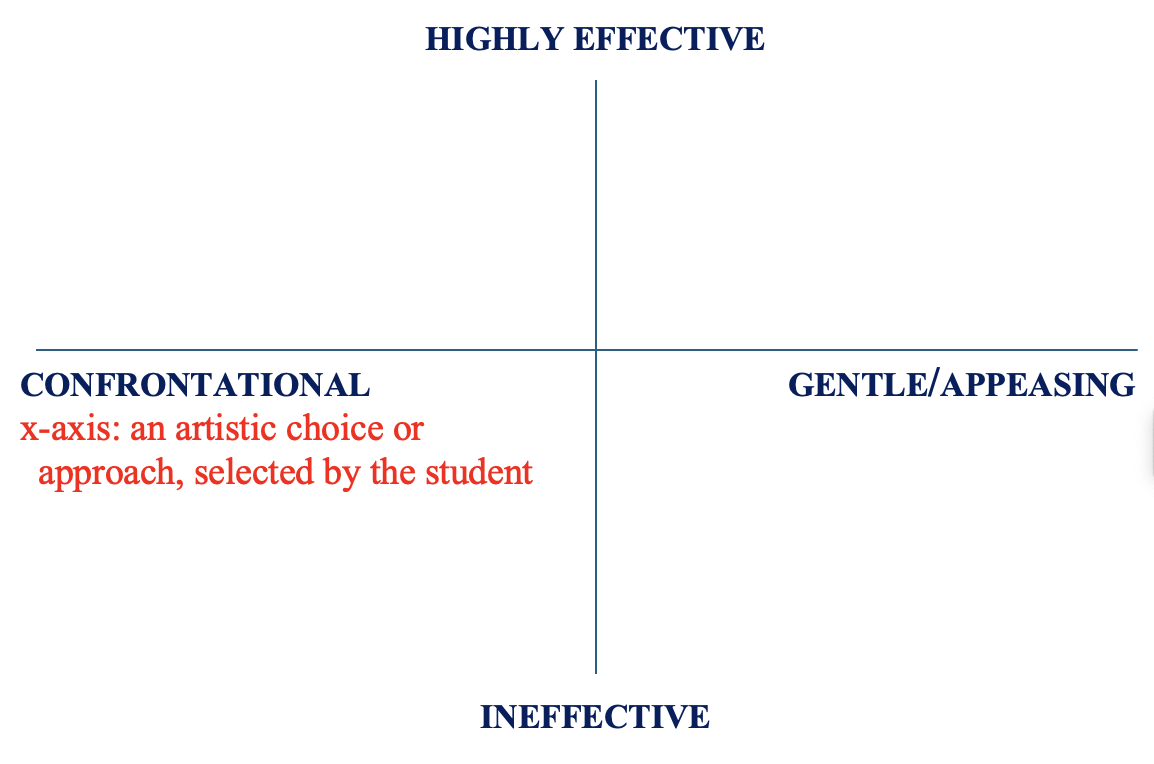
Before drafting a script for their video essay, students develop a matrix, which serves as both an organizing tool and a visual summary of their evaluation of each piece of evidence. Students typically select a variable for the x-axis that tracks an artistic choice or approach, while using the y-axis to depict the work’s effectiveness in raising social consciousness. As I’ve written elsewhere, "By assigning a quantifiable (and entirely subjective) value to each work of art, the matrix serves as a visual snapshot to capture" the student’s core argument and relationship to the artistic works examined in their essay (Udko 2025, para. 37). Embracing the individualized nature of spectatorship, students recognize that there is no right or wrong way to organize their evidence and that they will be making placement decisions that could differ significantly from their peers. One x-axis might measure the optimistic or pessimistic tone of a piece; another might assess the strengths and limitations of departing from realism (e.g., naturalism vs. absurdism). Figure 1 shows one potential iteration of a blank matrix focusing on the confrontational relationships between artists and their audiences.
By the time students complete their viewing journals and annotated bibliographies, they should have ideally located a work of art to place in each quadrant of the matrix. Exploring why a particular quadrant lacks an example leads students to new discoveries, complications, and perhaps a revised matrix. The matrix offers a liberating opportunity to slow down and see clear links between all the evidence in an argument without getting stuck in a particular linear ordering of evidence. This visual system resists any simple method of organization (chronological, best to worst, general to specific, compare-contrast, linear cause and effect, etc.) and it requires a student to make their own crucial ordering decisions. The matrix is one way to foster authentic, holistic, synthesized ownership of their thinking that is always subject to revision and movement. Items on the matrix move around throughout the brainstorming, writing, and editing processes. “When I write,” one student shared in a reflective letter, “I often feel as though I need to plan my entire essay before I write it, however, I don’t want to lose the ability to add in all my new thinking. The matrix felt like the solution I was missing. I was able to plan my thought process without causing undue stress.” In the final projects, this matrix often appears early on in the video essays, as students use it to lay out the groundwork for their investigations.
Once they have all their evidence, the students begin writing their audio tracks. The act of drafting, recording, condensing, re-recording, and editing of a voiceover audio track allows students to practice writing clear and concise prose. The maximum 8-minute length requires the class to practice condensing their arguments, identifying filler phrases, and eliminating redundancy. They discover that descriptions can often be replaced by images or text on the video track; the video track can economically offer subtle visual cues with color, text, headlines, or images of previously mentioned material to convey meaning without having to write lengthy descriptions.6
I encourage students to draft their scripts in their own voices, as they would speak to an intelligent friend. One student described that “writing the script with the knowledge that it will be spoken and recorded shifted my perspective on what my writing voice actually is. Despite teachers telling me my writing should always be in ‘my own voice,’ I think that I finally understood what that meant through this assignment.”
Each new artwork introduced in the video should function as a turning point, injecting a new dimension into the student’s analysis. The beginning sets up the central question of the essay, and through deeper examination with each turning point, the student should ideally end with a shift in thinking about this question. The goal is not to arrive at a definitive answer (as many AI-generated papers do), but rather to leave audiences with a deeper, more nuanced understanding about the ways artists engage with this social controversy.
While outlining their argument, I stress that each turning point should have one or more of the following elements in order to craft smooth transitions: (a) an implied sub-question attached to it; (b) a BUT/HOWEVER moment7; or (c) an acknowledgment that the findings of the previous turning point could be complicated further with an additional layer.
At its core, this progression of assignments aims to cultivate authentic thinking (and discourages the use of artificial intelligence) by challenging students to confront complexity, nuance, their own individual spectatorship, and ambiguity—qualities that ChatGPT can struggle to replicate. As I compose this essay, generative AI tools still lack the capacity for true introspection, emotional resonance, and the kind of personalized engagement that defines this project. While this assignment seems to foreground one form of technology (video editing) in response to the looming threat of a far newer technology, the same skills that guided this unit when it was a written essay remain front and center: meaningful reflection, accurate representation of evidence, responsible citation, organization of turning points, recursive movement, and graceful transitions.
Our students have grown up watching video essays on YouTube and TikTok; during their lifetimes, the form has become increasingly popular for transmitting information and views about complex issues. The popularity and familiarity with this form changes their relationship to the work; they are eager to create something that resembles the type of intellectual entertainment that they enthusiastically consume in their free time. In their final evaluations, students report overwhelming excitement about creating video content that can be shared with a larger public and describe the process as “rewarding,” “inspiring,” “fun,” “challenging,” and “time-consuming.”
Producing a video essay generally requires significantly more labor than writing a research paper. When I first started teaching this form, I worried that it would offer an unfair advantage to film students, and that those unfamiliar with editing software would struggle to complete the assignment. To the contrary, I have found that most students are eager to hone this skill and many have not yet had an occasion to practice the craft of video editing in an academic setting. One student wrote about how working simultaneously in audio and visual mediums inspired her to exit her comfort zone while increasing a sense of passion and investment in her topic: “I am usually vehemently against writing research essays, but this project forced me to become curious and I learned to love writing. I think it’s one of the best things to ever happen to me academically speaking.”
I believe that our students thrive when we give them the freedom to showcase their most authentic selves, while simultaneously offering constructive constraints that steer them towards complexity and nuance. In our current academic landscape, inventing new ways to maintain integrity can feel exhausting and futile. None of this work is AI-proof; a student could absolutely circumvent these deterrents if they wanted to use ChatGPT to write the script for their essay and Grok to generate video clips, but I find that they are more interested in representing the idiosyncratic evolution of their own thought process (and sounding like themselves) than they are in appearing right.
The act of integrating evidence from a myriad of sources (films, television, YouTube, TikTok, newspaper articles, academic journals) inspires students to think about integrity. For instance, we discuss the ethical use of citations (and how to keep track of all the video and written sources stitched into their final product in an ongoing document that will form their page of works cited). Etymologically, we explore how integration and integrity share a common Latin root (integer, meaning whole or complete). For example, what does moral uprightness and being true to a set of common values have to do with a sense of wholeness? Students come to see the acts of curating content, viewing, note-taking, researching, composing, speaking, recording, selecting clips, rearranging sequences, and editing as highly personal experiences. Many are motivated to create work that could not sound like it was created a few years ago or created by one of their peers.
The video essay fosters not only academic growth but also a deeper sense of individuality and creative confidence. We acknowledge the courage and vulnerability involved in screening their work in front of the class—and the ways one must exit a comfort zone in order to learn and grow. My course has been built on the premise that the craft of essay writing can make our Tisch students better artists; this final assignment (an invitation to simultaneously be both an artist and a scholar) attempts to bring this promise to fruition. Screening the fruits of their labor in front of the class, they come to see that their essays can be fully realized works of art. I continue to revise this assignment each semester to create the ideal conditions for students to introduce us to holistic, more complete versions of themselves than a traditional research paper would allow.
Select the social issue / controversy you would like to explore in this unit. Make a list of films, plays, and works of art associated with your issue. You will need to have at least 5 full-length works (plays, films, specific episodes of a television series, one documentary) on this list. Be sure that a full-length documentary (or 2 short documentaries) and at least 4-5 films/plays/television shows have been made on this topic—and that you have access to them.
Come to class with a list of all relevant and available artworks that deal with this topic. Include this list as the first page of your Viewing Journal for Unit 2 (an ongoing Google doc).
Your Viewing Journal will document all of your notes related to the choices made by your chosen artists regarding the representation of your social issue. Include time codes and page numbers in your Viewing Journal to facilitate an easier video editing process. In addition, create a Google folder where you will upload clips and images that you may consider using on your video track.
Now pick (1) a full-length documentary AND (2) at least TWO feature films/TV series/plays that engage with your social issue. If you can’t find a full-length doc, feel free to watch multiple short docs (minimum length: 30 minutes each) or TV specials (an episode of Vice, for example). Remember: Your final Viewing Journal must contain at least 5 full-length works.
Examples for Climate Change: An Inconvenient Truth (documentary), Don’t Look Up (feature film), Snowpiercer (feature film), The Day After Tomorrow (feature film), Flow (animated film), Earthquakes in London (play)
In your Viewing Journal (min 1 page single-spaced notes per work), explore how these works approach the controversy through a variety of different lenses. What choices stand out to you about the various approaches to this controversy? What gets left out as you cross over from the world of documentary to fiction? What are the strengths and limitations of the documentary form? How does your chosen fictional work deal with this controversy in unique and surprising (or stale and predictable) ways? Take notes about pivotal scenes from each selection in your analysis. (Bullet points are fine.)
Now record a video pitch (a 2-3 minute video of yourself talking to the camera about your social issue) to our NYU Stream Channel.
You will want to jot down a few talking points before you record, but this shouldn’t be scripted (keep it as informal as you like). Help us to understand the problem you are grappling with (and why it matters to you): Why have you decided to explore this controversy? What do many people still not understand about this issue? What would surprise your peers?
Narrow the focus of your controversy so that you can directly address the ways that Hollywood and artistic communities (theater, dance, visual art, music, performance art) are fueling or helping to solve this problem. As you talk, try to push past any obvious claims that we would all agree with; give us something new to think about, inspired by the work you have already done in your Viewing Journal (the documentary and two feature films you have seen).
What questions remain for you concerning the ways artists can engage with this social issue? What do you still not fully understand? What are you hoping to figure out by watching and reading several more works of art over the next month?
Watch your classmates’ videos and write comments on 3 of them on our Stream channel. Give constructive feedback in your comments (offer suggestions about plays, music, film, tv, dance, and visual art that engages with their controversy; ask questions that might highlight some blind spots; express any concerns that you have).
Start researching your own controversy (and its relationship to the Arts) on Twitter/X, TikTok, blogs, and in the popular press. You’re interested in public opinion: what are people saying about it? What are the trends? How do perspectives on this issue vary? Try to be as specific as possible in defining your controversy; Race would be too broad (police brutality and race is better). Make a list of questions you are thinking about at the top of your document.
Then turn to YouTube and find as many pertinent videos as possible related to your discussion: documentary shorts, TED talks, music videos, etc. Aim for a mixture of artistic and documentary-based responses to your controversy. Try to have:
At least one TED talk (or a lengthy, well-regarded presentation that resembles a TED talk)
At least one music video or performance (sketch comedy)
A mixture of well-known and more esoteric artistic responses to this issue (conceptual artists, visual artists, performance artists)
Select the 10 MOST USEFUL YOUTUBE VIDEOS from your search and create an Annotated Bibliography.
Below each citation, briefly describe the video and then explain how each one offers you a new perspective. If a video does not provide you any insight, it does not belong on your list. Write one hefty paragraph of original thinking for each video. Do not merely describe the video; tell me what you think about it—and how it leads you to ask new questions about your controversy (and its relationship to the art world).
Length: Approximately 1/3 of a page per entry, single-spaced.
List the Citation for the video using Proper MLA format:
Author’s Name or Poster’s Username. “Title of Image or Video.” Media Type Text. Name of Website. Name of Website’s Publisher, date of posting. Medium. Date retrieved. Link.
Do some further reading about your controversy from a variety of new perspectives (and disciplines) and select FIVE of the most useful essays you find from JSTOR, EBSCO, Project Muse, Google Scholar, The Economist, New Yorker, The Atlantic, The New York Times, Time, The Wall Street Journal, or other established periodicals. These selections should be lengthy ESSAYS, as opposed to brief news articles or blog posts. Make sure that some of these essays directly address the ways artists have represented your issue.
Follow the same format as your YouTube Bibliography, this time with texts. List the proper MLA citation. Summarize the text in 1-2 sentences and then spend the bulk of your paragraph explaining its contribution to your evolving understanding of this controversy.
Length: One substantial paragraph (approx. ½ of a page, single-spaced) for each text.
“The test of a first-rate intelligence is the ability to hold two opposed ideas in the mind at the same time, and still retain the ability to function.”
— F. Scott Fitzgerald, “The Crack-Up” (1936)
This final video essay asks you to explore the ways artists can engage with a public controversy. You will need a compelling central question, clearly defined by the end of your beginning. Your argument will be a nuanced response to this question, as you delve deeper into the complicated issues and discourses related to your controversy. You will be creating a video essay that will be presented to the class (with your narration and chosen images from the art/film/documentary/plays you have studied).
While you have freedom to structure your video essay in a variety of ways, I recommend designating one primary artwork (a film or a play) as the anchor for your discussion (while using additional films, plays, documentaries, and visual art as secondary evidence). Demonstrating your ability to read these artworks for explicit and implicit meaning will be a crucial part of this assignment. Pay careful attention to each artwork’s significance, intention, execution, and reception.
In addition to presenting the controversy’s different sides and perspectives, you must ground your theory with analysis of at least FIVE WORKS OF ART (films, plays, visual art).
As you investigate this question in the middle of your video, you should reference at least TWO TEXTS from your Annotated Bibliography as turning points. These texts should transform the way you think about the intersection of art and your chosen issue in some way. You should feel comfortable articulating the complex idea from one of these texts and using it as a lens that enables you to further develop your argument.
Principles from our course to keep in mind as you draft this essay: inductive vs. deductive reasoning, recursive movement, turning points, the development of your matrix, consideration of a counterargument, effective representative moments, relationships between form + content, experimenting with complex sentence forms, resisting either/or thinking or overly broad/unsubstantiated claims, ethical and appropriate methods of citations, crafting satisfying beginnings and endings, and recognizing different modes of artistic engagement
LENGTH FOR FINAL ESSAY FILM: BETWEEN 6-7 MINUTES (no more than 8 minutes)
For Week 6: Research and incorporate work by a visual, conceptual, or performance artist. Put notes about 2 artists in your Viewing Journal (one paragraph each with visual links). Continue developing your central question and matrix.
Write the beginning of your essay and outline all major turning points. Include your central question and matrix. Select your main artwork, status quo, destabilizing moment, problem, placement of other works on your Matrix, and your central question.
Then: how you will develop your argument using the rest of your artwork and evidence.
Also: Watch and take notes in your Viewing Journal about your 5th full-length work (play, film, tv show). Try to find a work that fills an empty quadrant on your matrix.
For Week 7: Keep working on your video essay script. Aim for a complete 4-page draft
For Week 8: Final draft of script for video essay due (around 3-4 pages, double-spaced). Record the vocal track for your video essay. Assemble the video track. Maximum length: 8 minutes
These texts include “Stereotype” by Anne Bogart (2001), “Publics and Counterpublics” by Michael Warner (2002), “Against Interpretation” by Susan Sontag (1966), “Culture” by Stephen Greenblatt (1995), as well as the following films by Bong Joon-Ho: Parasite (2019), Okja (2017), and Snowpiercer (2013).↩︎
While not every topic is political in nature, students select issues that could spark disagreements about the underlying causes, scope, urgency, or potential solutions. Because the assignment requires students to watch five full-length works of art, certain topics (traditionally ignored by Hollywood) are unavailable for selection. A few students from previous semesters have complained about this restriction. While these concerns are valid, this unit aims to develop a theory in response to art that already exists, not art that should exist.↩︎
I added this caveat after a semester when two students struggled to complete the assignment because they found the material they had selected too disturbing.↩︎
All student writing is shared with written permission.↩︎
A note on AI detection: During the first two years I taught this progression, I noticed that several students were using ChatGPT to generate pages of viewing journal notes in seconds. Because I do not want to rely on potentially flawed AI checkers to maintain a sense of integrity in my classroom and because I was spending far too much time focused on catching offenders, I now use Revision History (a Chrome add-on that provides a detailed log of how a Google Doc has evolved over time); we can see when changes were made, the nature of those changes, the number of minutes a students has spent typing, and whether the document was developed iteratively. I encourage students to download this extension and complete all of their work directly in a single Google Doc (avoiding any large copy/pastes), so they too can monitor their own process. I find that this tool supports academic integrity without policing and motivates students to approach writing as a process that necessitates brainstorming, note-taking, drafting, revision, and editing.↩︎
Most students use iMovie to edit their videos, although some have used Adobe Premiere, Final Cut Pro, or CapCut. For many students, this is their first experience editing a video, a skill that they are excited to refine. When navigating these applications, they turn to YouTube tutorials, and we spend very little time in class discussing the software. I have never had a student who has not been able to deliver a finished product due to technical difficulties.↩︎
Trey Parker and Matt Stone, the creators of South Park, preach this essential principle for television and screenwriting (MTVU 2011).↩︎