Engaging Students in Implementing Generative Artificial Intelligence: Creating Simple Infographics to Reinforce Sustainable Living Concepts
Theresa M. Crimmins
University of Arizona
theresam@arizona.edu
Kathleen L. Prudic
University of Arizona
klprudic@arizona.edu
Prompt 10.2. Submitted August 31, 2025; accepted May 22, 2026; published August 17, 2026. For the PDF version of this essay and any supplementary material accompanying it, visit https://doi.org/10.31719/pjaw.v10i2.278 .
Abstract: The rapid integration of generative artificial intelligence (GenAI) into educational settings has created
both opportunities and challenges for student learning. While GenAI adoption in education continues to
grow, instructors remain divided about its educational value and appropriate usage. To further complicate
matters, instructors are learning in real-time how this new and rapidly evolving tool works. Here, we
describe an assignment developed for a large-enrollment, 100-level general education, environmental
science course at the University of Arizona (RNR 150 - Sustainable Earth) that provides students with
structured opportunities to experiment with and critically evaluate GenAI tools. The assignment requires
students to create a public facing infographic about water conservation using Piktochart's GenAI platform
and then to evaluate and edit the style, format, and content of the AI output. Students then complete
reflective writing analyzing the strengths and limitations of AI-generated content. Students completing
this assignment in spring 2025 generally responded positively to using GenAI as a tool to support their
thinking and effort, recognizing the importance of GenAI now and in their future.
Introduction
Generative
Artificial Intelligence Has Landed
The rise and infusion of generative artificial intelligence (GenAI)
into nearly every facet of our lives has been swift and intense. GenAI
is now embedded in healthcare, transportation, retail, and
manufacturing, and GenAI was even recognized in two recent Nobel Prizes
(Maslej et al.
2025). A representative of Accenture, an international company
that offers strategy and consulting services in technology and
operations, recently referred to GenAI as “the fastest-growing
technology” he had seen in the history of the company (McKendrick
2024).
The rapid adoption of GenAI is also occurring in educational
settings, with mixed opinions and success. Pew Research Center reports
that 26% of teens aged 14-22 admitted to using ChatGPT for schoolwork in
2024, up from 13% in 2023 (Blake 2025). A meta summary
of recent surveys of students and faculty in higher education revealed
that over three quarters of students use GenAI in their studies in some
way (Mulford
2025). Support for the tools is varied, and students and faculty
alike noted the potential for GenAI to enhance learning and offer time
savings in some contexts. However, they also expressed concerns that a
heavy reliance on GenAI will decrease critical thinking and verbal
communication skills (Mulford 2025). Arguing the
downsides of GenAI in the classroom, professors of art history Drimmer
and Nygren (2025) flatly discourage the
incorporation of GenAI in the classroom.
The impacts of the rapid rise of GenAI are also being carefully
considered by leaders in the field of writing instruction. In 2023, the
Association for Writing Across the Curriculum (WAC) published a
statement regarding artificial intelligence, stressing the importance of
writing as a means to deep learning and cognitive development. In this
statement, the authors stress that the cognitive and social development
that emerges through the act of writing “cannot be replaced by AI
language generators” (Association for Writing Across the
Curriculum 2023, 1). In the same year, the Modern Language
Association and the Conference on College Composition &
Communication (MLA-CCCC) Joint Task Force on Writing and AI Members
argued that writing is a process as well as a product and warned of
several risks, to students, teachers, and the profession, of relying on
GenAI tools for generating written text (MLA-CCCC Joint Task Force on Writing and
AI 2023). Risks to students include missing out on thinking and
writing practice, an undervaluing of the act of writing, and increased
lingual injustice; risks to teachers include increased labor to keep up
with quickly evolving technologies; and risks to the profession include
a devaluation in writing and language by society. Yet, notably, both
statements also acknowledged the potential benefits of incorporating the
use of GenAI tools in writing and encouraged faculty to consider how
such technologies may benefit students in their thinking and
writing.
Even with these many risks, GenAI is very present in our lives and
professions. We contend that providing students safe spaces to
experiment with using GenAI and to critically evaluate the tool’s output
and their experience using it can assist with learning about both the
content of the assignment as well as good practices of how to work
productively and authentically with GenAI. The integration of GenAI into
university education in thoughtful, careful ways presents an opportunity
to advance digital literacy, communication, and critical thinking skills
among students and faculty. We designed this assignment with this
intention, recognizing that we are just at the beginning of the GenAI
revolution and knowing that our particular assignment will likely change
quickly as students, faculty, and GenAI itself evolves through their
collective experiences.
Our Student Audience
and Learning Goals
Here, we present an assignment that introduces students in a
100-level general education environmental science course at the
University of Arizona (RNR 150 - Sustainable Earth) to GenAI tools. RNR
150 is a freshman/sophomore level survey course on climate change and
its global impacts on societies, both past and present. It serves all
University of Arizona campuses and is offered in person and in an
asynchronous online environment with an average of 105 students per
term. The course is offered through both main and online campuses. The
students are predominantly pre-health, pre-business, and communications
majors, with lower representations from STEM fields. Students display a
wide knowledge base in subject expertise, digital literacy,
communication, and critical thinking, as expected in a university with
incoming students with highly variable levels of college preparation and
limited previous formal writing experience. The assignment has been
taught twice previously at the University of Arizona in 7.5-week online,
asynchronous sections of the course, but it is adaptable for
incorporation into large, entry-level classes such as ours.
In this assignment, students are introduced to using GenAI through a
relevant, real-world assignment with low-stakes writing. Specifically,
students are prompted to create an infographic using the free online
tool Piktochart, following structured guidelines. Piktochart is a free,
online platform that leverages AI models to create infographics,
presentations, posters, and social media graphics. The assignment first
asks students to create an infographic depicting water use in Arizona in
a sector of their choosing (dairy, golf, industry, or residential).
Students are also offered choice in the temporal period evaluated
(1970s, 1980s, 1990s, or recent present) and the location of focus for
their product (Yuma, Tucson, Phoenix, or Bisbee). Next, students must
adapt the infographic, changing incorrect information and adapting it to
reflect their own design choices. In the final aspect of the assignment,
students are asked to provide a short, written reflection describing
what the AI tool got correct, what they needed to change, and their
thoughts regarding their experience using the tool. Students are graded
on successful creation of the infographic using Piktochart, their
changes to the AI-generated product, and their reflection (see the Evaluation
Rubric included with the assignment in the Supplementary
Material).
This assignment incorporates several Writing Across the Curriculum
principles (International Network of WAC Programs
2014). First, by providing opportunities for agency in their
deliverable, this assignment embodies the principles of engaging
students in meaning-making and authentic learning experiences in their
writing. Students are encouraged to carefully consider what the GenAI
tool created based on the prompt and what needs to be changed to be
sensical and appropriate. As well, because the topic of the activity
focuses on the locally relevant issue of water use, this activity
engages students in research and synthesis in a real-world, applicable
way. The grading of the students’ reflections reflects WAC principles by
placing focus on the process of writing and thinking. This reflection is
primarily graded on students’ insights; points are not taken off for
grammar or writing style, reducing the stakes for students to put pen to
paper. The focus in grading is on process—the experience working with
Generative AI and evaluating the outputs—rather than on the final
product.
In this assignment, we attempt to pull back the curtain on AI use for
students, providing them with the foundation for using the Piktochart
tool (https://piktochart.com)
effectively to improve their work and creative process. Our perspective
is that computers are not humans, and it is the student’s responsibility
to instruct the computer and check its work, rather than allowing the
computer to drive the creative process and final product. The assignment
could easily be adapted for use at other universities by swapping in
different regional or disciplinary issues, and it would work well in
other course formats, including online synchronous and in-person.
Assignment Overview
This assignment appears in Module 2 of a five-module course, at the
conclusion of a unit focused on present-day environmental changes and
their impacts on human societies globally. Prior to initiating this
assignment, students have engaged with a lecture unit introducing them
to the concepts of the unique physical properties of water, the critical
nature of water for survival of all living things, its uneven
distribution around the globe, and how access to water shapes
societies.
Students use Piktochart’s GenAI platform to generate an infographic
addressing changes in water usage in Arizona, tailored to a specific
audience and time period. Each student has the ability to choose their
own combination of variables; the prompt structure directs students to
specify the type of water user, geographic location, and time frame,
resulting in a focused and contextually relevant product.
Following the creation of the infographic, students are instructed to
make substantive edits to the infographic in three domains: factual
accuracy, stylistic presentation, and overall format. Students are
expected to consider whether the information provided by the GenAI tool
is valid and to verify it through consultation of trustworthy sources.
These edits are documented through before-and-after screenshots,
providing a transparent record of the revision process that is easy to
assess in a high-enrollment course.
In addition to the design and revision components, students are
required to compose a brief reflection detailing their design choices,
the strengths and weaknesses of the GenAI output, and the rationale
behind their editorial decisions and improvements in a one-page
low-stakes written reflection. This reflective element is central to the
assignment’s pedagogical goals; it encourages students to articulate
their personal and human engagement with both the technology and the
subject matter (O’Loughlin and
Griffith 2020). An optional extension invites students to
supplement their infographics with information sourced from
GenAI-powered research tools, further reinforcing the value of
evidence-based communication. We strongly prefer that the students not
use GenAI in preparing their reflection, as the reflection is the
critical step where they consider how well the technology performs. By
deemphasizing proper grammar and writing style in the reflection, we aim
to encourage students to share their own thoughts.
Experiences and Outcomes
Faculty Experiences and
Outcomes
This assignment has been taught twice, each time in a 7.5-week
online, asynchronous course environment. The second time the assignment
was implemented, we formally sought feedback from students regarding
their experiences using GenAI and with the overall assignment through a
for-credit chat post. To ensure students provided their honest feelings
about the assignment and their experience, points were awarded for the
chat post regardless of what was shared.
The initial implementation of this assignment in a formal classroom
setting yielded several notable outcomes. The assignment was delivered
without significant logistical challenges, and students were able to
navigate the technical requirements with minimal need for support.
Subsequent discussions revealed a high level of engagement, with
students actively reflecting on both the capabilities and limitations of
GenAI tools. From an instructional perspective, the assignment
facilitated meaningful dialogue around digital literacy, information
quality, and the evolving role of AI in academic and professional
contexts.
The diversity of student majors contributed to an array of
infographic products, each reflecting editorial choices and perspectives
seemingly informed by their disciplinary standards. The assignment’s
structure, which balances guided prompts with opportunities for
individual expression, proved effective in accommodating varying levels
of prior experience with GenAI technologies. The grading process was
streamlined for a high-enrollment class by the use of a detailed rubric,
while the reflective component provided valuable insights into student
learning and attitudes toward GenAI.
Student Experiences and
Outcomes
Approximately half of the students indicated previous experience with
GenAI platforms, while the remainder were encountering such technology
for the first time with this assignment. Some students reported a
previous deliberate avoidance of GenAI tools, citing concerns regarding
the reliability and authenticity of AI-generated information. One
student articulated this perspective succinctly, stating, “GenAI will
never be as genuine as someone’s own words.”
Despite initial reservations, most students ultimately agreed that
the assignment was interesting, enjoyable, worthwhile, and enlightening.
Several students highlighted the utility of GenAI in structuring
content. One student noted, “I liked that it generated section headers;
they helped me organize my topic into clear sections.” The assignment’s
requirement to edit the GenAI infographic for factual accuracy,
stylistic coherence, and audience relevance gave students guideposts
that shaped their evaluation of the GenAI output strengths and
weaknesses.
Notably, many students observed that while GenAI was effective in
generating visually appealing layouts and organizing information, the
content often was factually incorrect, sometimes ridiculously so.
Several students pointed out the GenAI-created photographs as
particularly inaccurate; other students noted that editing the results
was necessary for both factual accuracy and tailoring toward a
particular audience. One student accurately quipped, “AI would not
receive a good letter grade [on this
assignment] on its own.” Students also noted that GenAI
outputs lacked a human voice, “struggl[ing]
with the more imaginative aspects of design.” Another student shared the
insight that “AI should be used as something more as a framework rather
than a finished product.”
The reflective component of the assignment encouraged students to
articulate their editorial decisions and to consider the value added by
human intervention. It also helped students identify where their new
roles and skills in writing and communication might lie when working
with GenAI, such as creating a personal voice, identifying and focusing
on the target audience, and verifying content accuracy. Students
described the process of revising the infographics as an opportunity to
enhance both the clarity and credibility of the final product.
Students were encouraged to share their honest thoughts on the
assignment, and none shared a negative opinion, even when encouraged to
do so. The prevailing sentiment was that the experience was helpful for
revealing the weaknesses that can occur when using GenAI and how to
approach them. Many students expressed appreciation for being forced to
interact with the tools even when they did not want to and felt it was a
worthwhile learning experience. Through this exercise, students reported
increased confidence in their ability to use and critique GenAI tools,
as well as a greater appreciation for the importance of human oversight
in digital content creation. These responses were surprising, given that
approximately 40% of students in other general education courses in our
department have recently stated that it feels like cheating when they
are required to use GenAI for written assignments. Overall, this
assignment succeeded in fostering both technical proficiency and
critical awareness, equipping students with foundational skills for
navigating an information landscape shaped by emerging technologies that
will likely be part of their professional toolkit.
Reflections and Future
Applications
The outcomes of this assignment underscore the potential of GenAI as
both a pedagogical tool and a subject of critical inquiry. By requiring
students to engage directly with AI-generated content and to reflect on
their editorial decisions, the assignment fosters a more connected
understanding of the interplay between computer automation and human
expertise. The reflective component serves to deepen students’
metacognitive awareness and to promote the development of transferable
skills in information literacy and digital communication. Our experience
suggests that, as GenAI continues to change students’ engagement with
writing, WAC principles will need to be reconsidered.
Looking ahead, this is just the first of many revisions to this
assignment. We have considered incorporating peer review to provide
additional opportunities for collaborative learning and for exposure to
diverse approaches to editing and design. Expanding the range of topics
and audiences may further increase the assignment’s relevance and
appeal, while continued integration of GenAI-powered research tools can
reinforce the importance of evidence-based practice. Ultimately, this
assignment aims to prepare students to navigate a communication
landscape increasingly shaped by GenAI, equipping them with the skills
and ways of doing we see as necessary for critical engagement and
responsible authorship.
Acknowledgments
We recognize our students in RNR 150 Sustainable Earth at
the University of Arizona. We appreciate all your thoughts,
participation, and hard work. We thank Ben Pawlowski, UCATT
Instructional Designer, for assistance in testing the first versions of
the assignment and Scott Jones for incorporating the assignment into RNR
150 online. We thank the other authors of this special issue for their
thoughts and feedback, and we are grateful to two anonymous reviewers
for their insightful and helpful comments. We respectfully acknowledge
the University of Arizona is on the land and territories of Indigenous
peoples. Today, Arizona is home to 22 federally recognized tribes, with
Tucson being home to the O’odham and the Yaqui. Committed to diversity
and inclusion, the university strives to build sustainable relationships
with sovereign Native Nations and Indigenous communities through
education offerings, partnerships, and community service.
ASSIGNMENT Employing GenAI to Create an Infographic
Assignment Learning
Objective
Analyze GenAI created data visualization (informatic) for fact,
audience, and design (20 pts)
An edited infographic co-created by you and GenAI tailored to a
particular audience and place; documentation of your prompt; a short
reflection on what GenAI did well and where it did not perform well, how
a human editor improves GenAI products, and what the next set of
improvements would be if you had more time and expertise.
Background Scenario
You are a program manager of a local non-government agency focused on
water usage in the state of Arizona. You are responsible for creating
communications materials for your website that show the changes in
Arizona water usage over the past 50 years. Your audience includes four
audiences: the general public and land managers across three settings
(agriculture, wildlands, and urban). Your goal is to produce a website
infographic for all the audiences that is factually correct and
engaging.
The audience for this assignment is the general
public; the purpose of this assignment is to inform and
motivate action by the audience; and the organization and style
of this assignment is an infographic provided by a
non-profit.
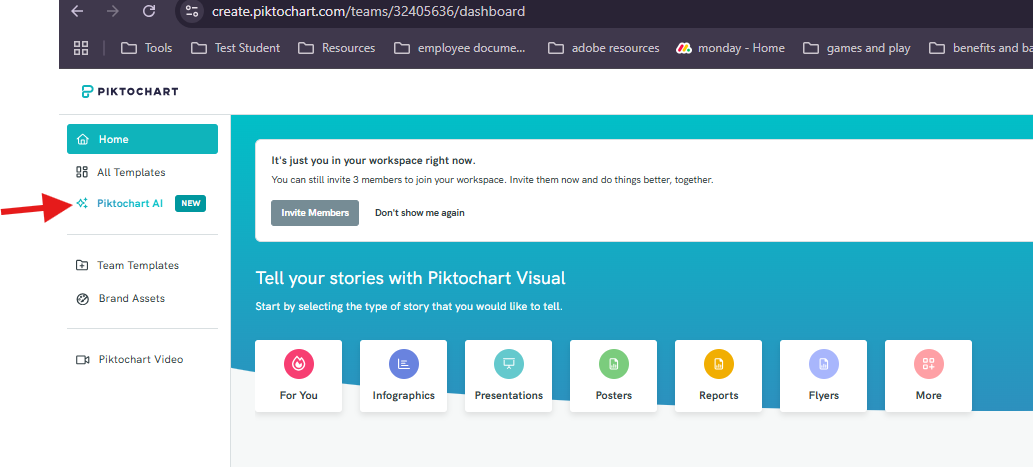
Once you have registered and logged in, navigate to the AI tool,
called Piktochart AI (Figure 1).
Figure 1. Screenshot of Piktochart dashboard. Arrow on left side
points to link for Piktochart AI.
Provide the following text prompt to Piktochart AI. “Create an
infographic about water usage by (1) in (2) from (3).” Populate the
blanks 1, 2, and 3 with one of the choices provided for each number
below.
Create an infographic about water usage
by:
(1)
in
(2)
from
(3)
dairy farms
Yuma
1965-1980
golf courses
Tucson
1980-1995
industrial parks
Phoenix
1995-2010
residents
Bisbee
2010-2024
Tailor your prompt with these choices: (1, choose one): dairy farms,
golf courses, industrial parks, or residents. (2, choose one): Yuma,
Tucson, Phoenix, or Bisbee (3, choose one) 1965-1980, 1980-1995,
1995-2010, or 2010-2024
Edit the infographic on these three aspects: fact, style, and
format tailored to your audience and personal aesthetic with a
minimum of 1 change for each category, highlighting those
changes.
The easiest way is to make edits on the Piktochart website then take a
screenshot. You will take two screenshots: one of the infographic before
you make any edits, one after you make your edits. Both screenshots will
be included in your assignment (see Sample Response in the Supplementary Material). Label them “draft” and
“revised infographic”.
Write a brief reflection (no more than 20 sentences) on how you
chose your particular infographic design, what the GenAI algorithm did
well, and what edits you made to improve the infographic. Use your own
words filled with your personal voice and human emotion that is creative
and insightful, not GenAI please. The focus here is on sharing your
thoughts; you will not be graded on your writing style or perfect use of
grammar.
Include your original GenAI prompt and the course GenAI citation
in your write-up.
Format your assignment like the example (see Sample Response in the Supplementary Material), and remember to cite the GenAI
platform per course policy please!
Drimmer, S., and C. J. Nygren. 2025. “How We Are Not Using
AI in the Classroom.”ICMA News: The Newsletter
of the International Center of Medieval Art 1 (1): 25–28.
Maslej, Nestor, L. Fattorini, R. Perrault, Y. Gill, V. Parli, N.
Kariuki, E. Capstick, et al. 2025. The AI Index 2025
Annual Report. Stanford University, Stanford, CA: AI
Index Steering Committee, Institute for Human-Centered AI. https://doi.org/10.48550/arXiv.2504.07139.